Showing posts with label BAPS. Show all posts

Wednesday, 19 December 2012

BAPS Swaminarayan Sanstha


Worldwide

Bochasanwasi Shri Akshar Purushottam Swaminarayan Sanstha (also known as ‘BAPS Swaminarayan Sanstha’ or simply ‘BAPS’) is a worldwide community-based spiritual organisation with its beliefs firmly rooted in the Vedas. Revealed by Bhagwan Swaminarayan in the late 18th century and established in 1907 by Swami Yagnapurushdas (Shastriji Maharaj), BAPS strives to fulfil the spiritual and social needs of people while promoting inner peace and harmony between individuals, within families, and among communities.
Recognised and appreciated internationally for its humanitarian services and commitment to holistic social uplift, BAPS has received many national awards and is closely affiliated with the Economic and Social Council of the United Nations. It reaches out to millions of individuals through its network of over 3,300 centres, 890 sadhus, 55,000 volunteers, and the dedication of over one million followers in 45 countries. Today, under the spiritual and administrative leadership of His Holiness Pramukh Swami Maharaj, BAPS is respected and valued by millions.
To learn more about BAPS Swaminarayan Sanstha and its worldwide activities, visit www.baps.org.
Information about its worldwide centres can be found here.

Other BAPS Mandirs

In total, there are currently 34 traditional shikharbaddha mandirs of the BAPS Swaminarayan tradition around the world. In addition to the one in London, there are four in North America – in Atlanta, Chicago, Houston and Toronto – one in Nairobi, Kenya, and the rest can be found in various cities, towns and villages of India. Click here for a complete list or here to see a gallery of their photographs.
To learn more about the fascinating Swaminarayan Akshardham mandir complexes in New Delhi and Gandhinagar, Gujarat, please visit www.akshardham.com.

His Holiness Pramukh Swami Maharaj


His Holiness Pramukh Swami Maharaj is the fifth spiritual successor of Bhagwan Swaminarayan and the present guru of BAPS Swaminarayan Sanstha. He is the vision and inspiration behind BAPS Shri Swaminarayan Mandir, and under his leadership, BAPS has grown into a dynamic spiritual organisation with over 3,300 centres worldwide.
Despite his increasing age and ailments, Pramukh Swami Maharaj continues to dedicate his life for the well-being of others, travelling throughout the world to foster love, peace, harmony, righteousness, faith in God, and community service. His compassion for humanity, deep concern for its problems, and conscious efforts to alleviate them have inspired international moral, social, educational, cultural and spiritual projects. His striking humility, wisdom and spirituality have touched many world religious and national leaders, and inspired millions to lead a God-centred, moral life guided by Hindu principles. Driven by his quiet, undisturbed love for God, and with his genuine care and compassion, he remains a “people’s guru” reaching out to all, irrespective of age, class, colour or creed.
Pramukh Swami Maharaj is recognised and respected as one of Hinduism’s great spiritual teachers.
He lives by and preaches the message: “In the joy of others, lies our own.”

Profile

  • Birth: 7 December 1921; Magshar Sud 8, VS 1978
  • Birthplace: Chansad, Gujarat
  • Initiation: 10 January 1940; Posh Sud 1, VS 1996
  • Guru: Brahmaswarup Shastriji Maharaj
  • Spiritual Head since: 23 January 1971; Posh Vad 11, VS 2027
  • Villages visited: Over 15,500
  • Countries visited: Over 50
  • Homes sanctified: Over 250,000
  • Letters read and replied: Over 500,000
  • Personally counselled and comforted: Over 810,000 people
  • Discourses delivered: Over 20,000
  • Mandirs built and consecrated: Over 1,070
  • Sadhu disciples: Over 890
To learn more about Pramukh Swami Maharaj, please click here.
To see a gallery of photos revealing Pramukh Swami Maharaj’s role in the Mandir’s creation, please click here.

Pramukh Swami Maharaj

The Inspirer and Present Guru of BAPS Swaminarayan Sanstha

He has a heart wherein the whole world can live

Content
:


The present spiritual leader of the Bochasanwasi Shri Akshar Purushottam Sanstha (BAPS), Pramukh Swami Maharaj, represents a succession of spirituality that began a little over 200 years ago in 1781. The year marked the birth of the founder of the Swaminarayan Faith, Lord Swaminarayan (1781-1830).

Born in the village of Chhapaiya, near Ayodhya, in North India, Lord Swaminarayan renounced home at the age of 11 to embark on a pilgrimage on foot that took him across the length and breadth of India. He received initiation from a Vaishnav Guru, Ramanand Swami, and eventually settled in Western India. He spent the next 30 years of His life in Gujarat and Kathiawad, spearheading a socio-spiritual revolution. With a faithful following of 2000 sadhus, He established the Swaminarayan Sampradaya. He introduced innovative social reforms and undertook charitable work to help the poor and needy. In the tradition of the Bhakti Sampradaya He constructed six grand temples. His work concentrated on promoting personal morality and moulding spiritual character. In His own lifetime, He was worshipped as God by some two million devotees. By the time He passed away at the age of 49 He had earned a reputation as a great socio-religious reformer. The movement He founded emerged as one of the purest forms of Hinduism.

Through His spiritual presence, Lord Swaminarayan continues to provide energy and experience through a succession of God-realised spiritual masters. The first guru in the succession was His choicest devotee, Gunatitanand Swami (1785-1867), the manifestation of Aksharbrahman. He in turn was followed by Bhagatji Maharaj (1829-1897).

After him, Shastriji Maharaj (1865-1951) furthered the teachings by establishing the philosophy of Akshar and Purushottam. In consonance with the teachings of Lord Swaminarayan, Shastriji Maharaj propagated the worship of Lord Swaminarayan as Purushottam and Gunatitanand Swami as Aksharbrahman. He built five glorious temples and established the dual worship of God along with His choicest devotee. He founded the Bochasanwasi Shri Akshar Purushottam Sanstha (BAPS) - a socio-spiritual organization in 1907.

The fourth spiritual master was Yogiji Maharaj (1892-1971), whose work spread the message of Lord Swaminarayan overseas to East Africa and England, also planting seeds in the USA. He passed away after placing the oars of the Faith in the hands of Pramukh Swami Maharaj in 1971. Under his able leadership and guidance, BAPS has continued to contribute to the peace and harmony of society.

Inspired by Pramukh Swami Maharaj, the Sanstha has enjoyed remarkable success in international festivals celebrated in 1981 (Bicentenary Celebrations of Lord Swaminarayan), 1985 (Bicentenary Celebrations of Gunatitanand Swami) and 1992 (Centenary Celebrations of Yogiji Maharaj). The spectacular ‘Cultural Festivals of India’ held in London, 1985 and in New Jersey, 1991 were overwhelmingly successful in conveying the timeless messages from the rich heritage and culture of India.

A whole array of educational, enviromental, medical, social, moral, cultural, spiritual and other humanitarian activities flourish under Swamishri's guidance.

Swamishri himself leads an austere life, without personal gains or comforts. Possessing nothing, wanting nothing, he goes around giving his all. Despite his age, he untiringly travels from tiny tribal huts to modern metropolitan cities all over the world, promoting a virtuous life full of moral and spiritual power. At his tender word, thousands have shed addictions and walked the path of God.

His striking humility, profound wisdom and simplicity have touched many. His love for mankind and respect for all religions is weaving a fabric of cultural unity, interfaith harmony and universal peace.

The sole reason behind his unique success is a deep and fluent communion with God.

Tuesday, 18 December 2012

Swaminarayan Mandir IN London Murti Darshan


Daily Murti Darshan IN London

Therefore, in the mornings during weekdays the sacred images are adorned in a manner of a child attending school. Weekends are holidays and are devoted to leisure activities."


Daily Murti Darshan is uploaded every morning at 8.15am (local time) after the Shangar Arti.
This is today's darshan if you were to visit BAPS Shri Swaminarayan Mandir, London.

Exhibition, Understanding Hinduism


Exhibition: ‘Understanding Hinduism’

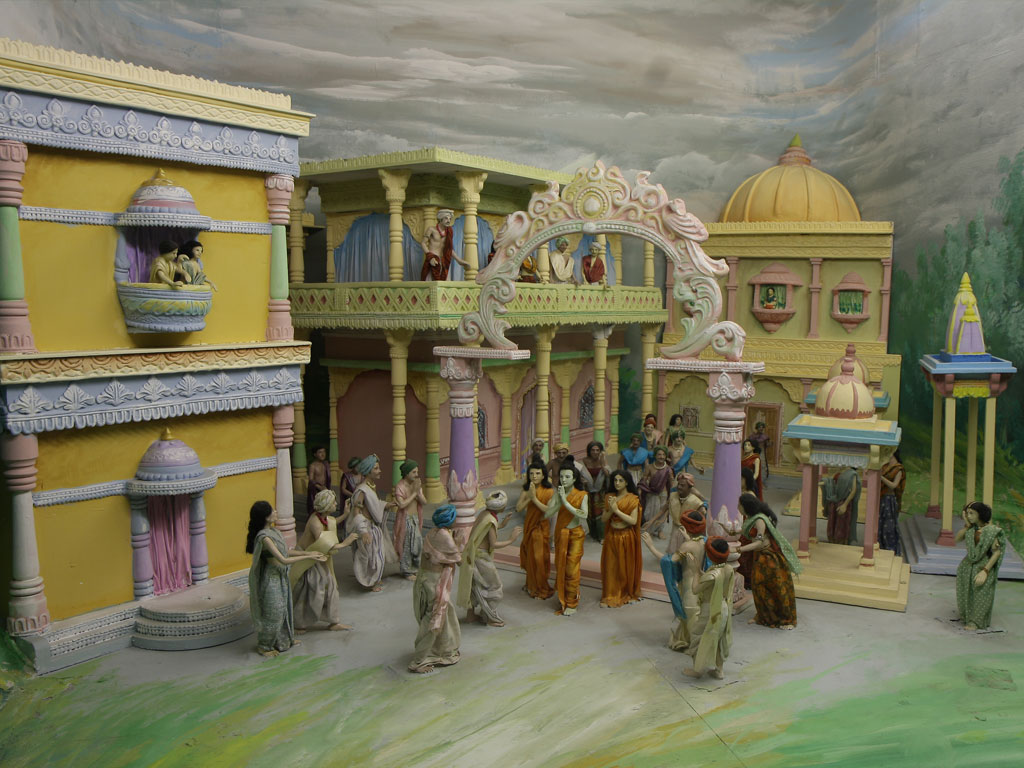
The lower floor of the Mandir is dedicated to a permanent exhibition. Spread over 3,000 square feet, it provides an educative insight into the values and wisdom of Hinduism through 3D dioramas, paintings, tableaux and traditional craftwork.
Visitors can learn about the origin, beliefs and values of Hinduism, the contribution of Hindu seers, and how this ancient religion is thriving today through traditions such as the Swaminarayan Sampradaya.
The exhibition also features an 11-minute documentary which narrates the Mandir’s religious significance and the story of its creation – from inception to ceremonial consecration.

BRIEF OVERVIEW

Auspicious Welcome

Aum – the primordial Hindu sound and sacred symbol provides a peaceful and auspicious welcome into the exhibition.

Origins, Growth, Beliefs

The ancient Vedic civilisation flourished around the sacred rivers of India – the Saraswati, Sindhu and Ganga. Depicted by an entwining glass stream and cavern-like panoramic murals, this opening section helps introduce Hinduism through its origins, growth and beliefs.
To learn more about what is Hinduism and its principal beliefs, or for some FAQs about Hinduism, please follow the respective links.

Hinduism for the Individual

Colourful 3D miniature dioramas tell the stories of Sita, Shravan, Nachiketa and Rantideva, explaining some of the inspiring values and principles of the Hindu faith that uplift the individual – faithfulness, duty, purpose, and charity.

Hinduism for Society

Some of the most remarkable discoveries of the world have been the contributions of Hindu seers and scientists. Their vision and Hinduism’s inclusiveness have helped society advance in a myriad of fields. Summarised in this section are these contributions in literature, language, education, mathematics, geometry, astronomy, surgery, and more.
It also pays tribute to the pillars of the Hindu faith through whom it has survived and flourished – from ancient sages such as Veda Vyas to modern luminaries such as Swami Vivekanand.

Hinduism for the World

Three luminescent globes convey the prayers and sentiments of the Hindu faith for the world as visitors learn how it cares for humans, animals and nature. The fundamental belief is: ‘The whole world is one family.’

The Swaminarayan Sampradaya

Hinduism is a family of many diverse religious traditions, each with its own beliefs, practices and sacred writings. One of these traditions is the Swaminarayan Sampradaya.
With its roots in the Vedas, and with a wealth of spiritual knowledge and continuous nourishment from a succession of enlightened gurus, the Swaminarayan Sampradaya has grown into an active worldwide fellowship. Understanding it helps one understand Hinduism and its relevance in our modern world today.
This section briefly introduces the life, work and teachings of Bhagwan Swaminarayan, including his:
  • Miraculous childhood
  • Teenage asceticism as Nilkanth Varni
  • Unique prayer as he began his ministry
  • Ordination of 500 paramhansas (Hindu monks of the highest order) in one night
  • Work of social and religious uplift among the neglected and needy
  • Shikshapatri (a small instructional book of daily living) and Vachanamrut (a compilation of 273 of his sermons providing a detailed exposition of his theology and spiritual practices)

With Bhagwan Swaminarayan living and working for almost 30 years in the central Gujarat region of Kathiawad, this area of the exhibition is depicted as a rustic courtyard as it would have looked in the early 19th century.

Hinduism Today

Today, over 200 years on, the Swaminarayan Sampradaya thrives through many denominations, one of which is BAPS Swaminarayan Sanstha (BAPS).
This final section offers a glimpse into the worldwide activities of BAPS, showing how the beliefs, values and practices of Bhagwan Swaminarayan and Hinduism live on in the daily lives of individuals, families and communities.

Timings

Mon-Fri: 9.00am to 5.00pm
Sat-Sun: 9.00am to 6.00pm

Entrance Fee (includes guidebook)

Adults: £2.00
Children (ages 6-16): £1.50
Senior Citizens: £1.50
Payment can be made at the door by cash, cheque or credit card.

Guidebook

An informative guidebook covering the content of the exhibition is available from the Souvenir Shop.

Principal Hindu Beliefs


Principal Hindu Beliefs

Hinduism embraces many diverse traditions, each with its own theology, philosophy, rituals, code of practices and value system. Despite this diversity, most Hindus share some common beliefs. These include the following:
  • Parabrahman (Supreme God): There is one supreme, all-powerful loving God. He is the creator, has a divine human form, is immanent, transcendent, and the granter of liberation.
  • Avatarvad (Descent of God on earth): God ‘descends’, or manifests, on earth in various forms to revive dharma and grant liberation.
  • Karmavad (Law of Action): According to its past and present actions, the soul reaps fruits, good and bad, which are experienced either in this life or future lives.
  • Punar-Janma (Reincarnation): The immortal soul is repeatedly born and reborn in millions of life-forms until it attains liberation.
  • Moksha (Ultimate Liberation): The goal of human life is for the soul to be liberated from the perpetual cycle of births and deaths so as to remain eternally in the blissful service of God in his transcendental abode.
  • Guru-Shishya Sambandh (Guru-Disciple Relationship): The guidance and grace of a spiritually enlightened teacher is essential for an aspirant seeking liberation.
  • Dharma: This is an all-encompassing term representing divine law, inherent nature, path of righteousness, religion, duty, responsibility, virtue, justice, goodness and truth.
  • Veda-Pramana (Authority of Vedic Scriptures): Hindu faiths accept the spiritual authority of the four Vedas, each of which comprises the Samhitas, Brahmanas, Aranyakas, and Upanishads. (Individual traditions may also have their own sacred texts which derive their authority from this Vedic corpus.)
  • Murti-Puja (Worship of Sacred Images of God): Devotees worship images ritually infused with the presence of God to develop and express their relationship with him.

BAPS Abhishek Mandap IN London

Abhishek Mandap

Main-Image
The Abhishek Mandap is a marble chamber on the lower floor of the main Mandir housing the sacred image of Shri Nilkanth Varni, the teenage form of Bhagwan Swaminarayan.
After renouncing his home at the tender age of 11, Bhagwan Swaminarayan embarked upon an epic journey of spiritual awakening that took him around India, into Nepal and Tibet, and through Myanmar (Burma) and Bangladesh. During this time, he came to be known as Nilkanth Varni. Barefooted and alone, Nilkanth walked more than 7,000 miles over 7 years, blessing the land and liberating numerous spiritual aspirants along the way. Carrying no maps, no food and no money, he crossed raging rivers, faced ferocious animals, and survived the freezing winter of the Himalayas. His solitary journey is a story of courage, kindness, and enlightenment.
To commemorate and pay tribute to Bhagwan Swaminarayan’s arduous journey, Pramukh Swami Maharaj ceremoniously dedicated the murti of Nilkanth Varni at the Mandir on 6 September 2004 allowing for a daily routine of abhishek and worship.
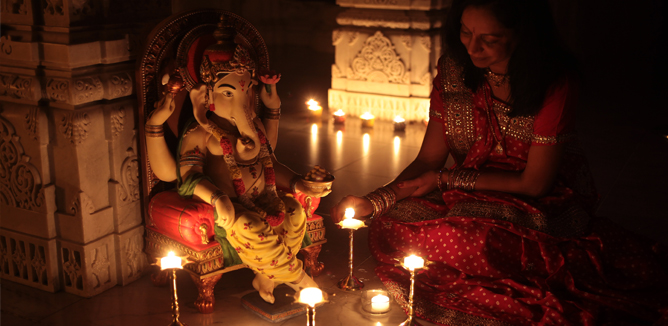
Abhishek is the ancient Hindu practice of pouring water over the sacred image of God to honour him and to attain his blessings. It is also an opportunity for devotees to pray to God, asking him to cleanse one’s soul. To learn more about the abhishek ritual and its religious significance, please click here.
The chamber itself is clad with Italian Carrara marble, while the murti of Nilkanth Varni is gilded brass.
He is depicted mid-step (in classical contrapposto pose); emaciated, yet with a calm and resolute look. With hair matted above and a small gutko (handwritten manuscript with excerpts from sacred texts) wrapped in a kerchief around his neck, he is wearing nothing but his loincloth tied at the waist by a jute cord. In his left hand, he is carrying a dand (wooden staff) and kamandalu (drinking pot made from dry gourd), both common marks of Hindu asceticism. The pedestal upon which he stands and the delicately designed lotus basin into which the water falls are both cast in brass.


Abhishek


Abhishek

Abhishek is the ancient Hindu practice of pouring water over the sacred image of God to honour him and to attain his blessings. It is also an opportunity for devotees to pray to God, asking him to cleanse one’s soul.
On special occasions, panchamrut – a holy mixture of milk, yogurt, honey, sugar and ghee – is used instead of water.
In the Abhishek Mandap on the lower floor of the Mandir, a gilded brass image of Shri Nilkanth Varni (Bhagwan Swaminarayan) has been enshrined to commemorate and pay tribute to his epic journey as a teenager.
Abhishek of this small sacred image is performed daily to the chanting of Vedic verses, including the ancient peace-prayer called the Shanti-Paath, and the recital of the 108 auspicious and liberating names of Bhagwan Swaminarayan, called the Janmangal Namavali. In all, the complete ceremony takes around 15 minutes, and is performed daily between 9.30am and noon, and again from 4pm to 5.30pm.
Devotees often offer an abhishek – or arrange for one to be performed on their behalf – on days of special significance to them, such as a birthday, wedding anniversary or in remembrance of a loved one, or sometimes to seek blessings for a personal reason.

BAPS How It Was Made


How It Was Made


Main-Image
Not in modern times had a traditional stone mandir of this scale and intricacy been created outside of India. It was the first time ever in the western world.

The Multi-Fold Challenge

Firstly, the Mandir had to conform to India’s ancient architectural texts, the Vastu Shastras, and yet also meet the requirements of Britain’s stringent building code.
Secondly, which stone would be durable enough to withstand the harsh British weather, strong enough to be self-load-bearing without any steel reinforcement or support (as prescribed by the Vastu Shastras), and soft enough for intricate carving?
Thirdly, how would this stone be brought together with the finest Hindu craftsmanship found only in India and be transported to north-west London?

After much research, deliberation and innovative engineering, along with much-needed guidance and blessings from His Holiness Pramukh Swami Maharaj and the tireless efforts of thousands of volunteers, the pieces of this giant puzzle began to fall into place – quite literally.


Almost 3,000 tonnes of Bulgarian limestone was shipped 3,900 miles to India along with 1,200 tonnes of Italian Carrara marble, which made its own journey of 4,800 miles.
With a further 900 tonnes of Indian Ambaji marble, the over 5,000 tonnes of stone was hand-carved by more than 1,500 skilled artisans at 14 different sites around India into 26,300 pieces. These were then coded, packed and sent on their final 6,300-mile journey to London where each piece – the largest weighing 5.6 tonnes and the smallest only 50 grams – was assembled like a giant 3-dimensional jigsaw puzzle, all within 2.5 years.