Showing posts with label Mandir Art. Show all posts

Tuesday, 18 December 2012

BAPS How It Was Made


How It Was Made


Main-Image
Not in modern times had a traditional stone mandir of this scale and intricacy been created outside of India. It was the first time ever in the western world.

The Multi-Fold Challenge

Firstly, the Mandir had to conform to India’s ancient architectural texts, the Vastu Shastras, and yet also meet the requirements of Britain’s stringent building code.
Secondly, which stone would be durable enough to withstand the harsh British weather, strong enough to be self-load-bearing without any steel reinforcement or support (as prescribed by the Vastu Shastras), and soft enough for intricate carving?
Thirdly, how would this stone be brought together with the finest Hindu craftsmanship found only in India and be transported to north-west London?

After much research, deliberation and innovative engineering, along with much-needed guidance and blessings from His Holiness Pramukh Swami Maharaj and the tireless efforts of thousands of volunteers, the pieces of this giant puzzle began to fall into place – quite literally.


Almost 3,000 tonnes of Bulgarian limestone was shipped 3,900 miles to India along with 1,200 tonnes of Italian Carrara marble, which made its own journey of 4,800 miles.
With a further 900 tonnes of Indian Ambaji marble, the over 5,000 tonnes of stone was hand-carved by more than 1,500 skilled artisans at 14 different sites around India into 26,300 pieces. These were then coded, packed and sent on their final 6,300-mile journey to London where each piece – the largest weighing 5.6 tonnes and the smallest only 50 grams – was assembled like a giant 3-dimensional jigsaw puzzle, all within 2.5 years.


BAPS Assembly Hall


Assembly Hall


The central feature of the Haveli is the assembly hall located behind the foyer. It is the focal point of the weekly assemblies as well as the religious festivals celebrated around the year at the Mandir.
Spanning 50 metres by 45 metres (165 feet by 145 feet), and with no supporting columns, the hall can accommodate up to 2,500 people when fully opened. The main stage, stretching 28 metres (90 feet), is from where the regular sermons and programmes are delivered. With folding partitions, the hall can also be sectioned into two halves or a front half with two back quarters, each with independent lighting and audio-visual facilities as well as its own stage.

Each of the four quadrants is carpeted in the Haveli’s bespoke broadloom, richly patterned and coloured with traditional Indian designs. Surrounding them is polished wooden flooring.
Above, the ceiling comprises of four large lightwells, each surrounded by intricately carved wooden struts (angled supports) and patterned grills. In addition to these natural sources, light is also provided by specially designed suspended lanterns, characteristic of the classic Haveli genre but fitted with energy-saving bulbs.
Also in the ceiling, a thermal heat exchanger conserves the thermal energy dissipated by the congregation and reuses it to heat other parts of the complex.
Other furnishings and mouldings in the hall, such as the arched niches skirting around the upper walls, are also inspired by traditional Haveli architecture.
The assembly hall is where many of the presentations for schools and group visits take place, and is a hub of activity for the thousands of devotees who come to learn, worship and celebrate at the Mandir.

Art & Architecture


Art & Architecture


Main-Image
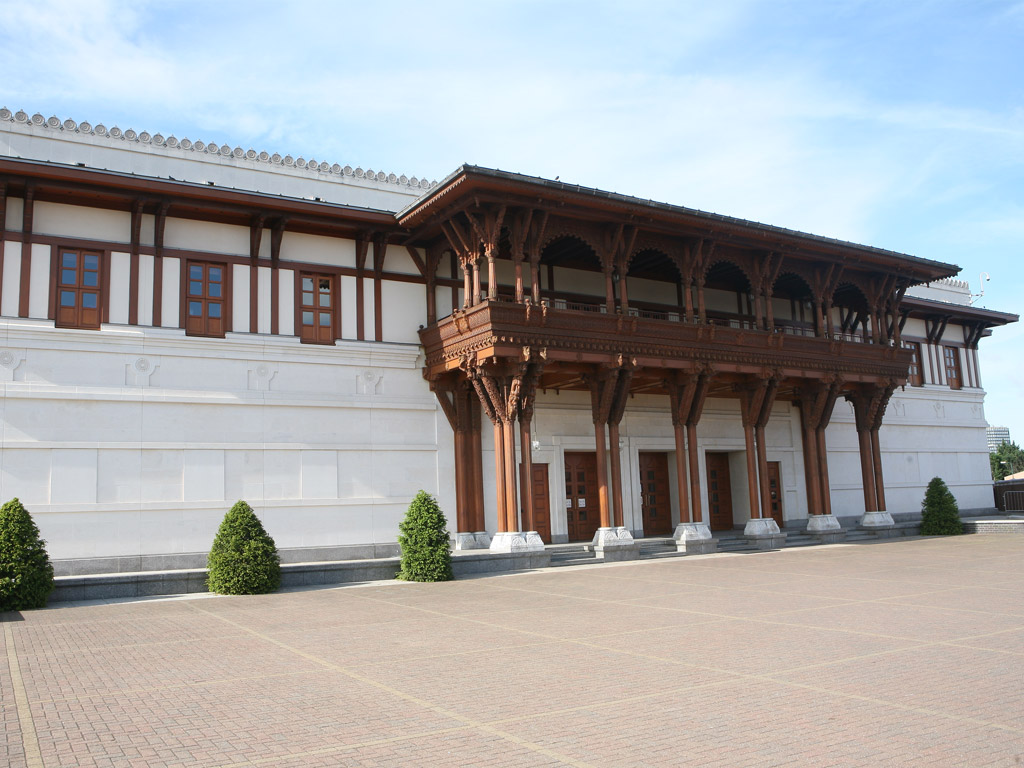
Adjacent to the stone Mandir is the Haveli, a unique cultural centre exquisitely crafted from wood.
Providing modern amenities and built with innovative environment-friendly features, it is a hub of activity for all who come to learn, worship and celebrate at the Mandir.
Intricately carved in Burmese teak and using English Oak, it is a masterpiece of traditional Haveli architecture – a genre that developed around the 17th century in Gujarat and Rajasthan in western India. Characterised by porch façades and central open courtyards, it is known for its array of profusely carved columns, struts (angled supports), arches, doors, windows and balconies.
As a dying art form, not in the past 100 years had such a haveli been created in India or elsewhere.

Façade

The Haveli is entered through the richly carved portico. Atop the fluted columns (‘pillars’) and along the sculpted panels and struts are a breathtaking parade of elephants, lions, peacocks, swans and parrots – all said to accord a cordial and auspicious welcome to worshippers and visitors.
On the upper floor, the balcony’s curvilinear balustrade (enclosing barrier) is a frieze (carved panel) teeming with floral and geometric patterns. The jutting canopy above is supported by tapering columns and twinned struts. In between, cusped arches feature images of the sun and moon – a further salutation to the forces of nature and time.

Courtyards

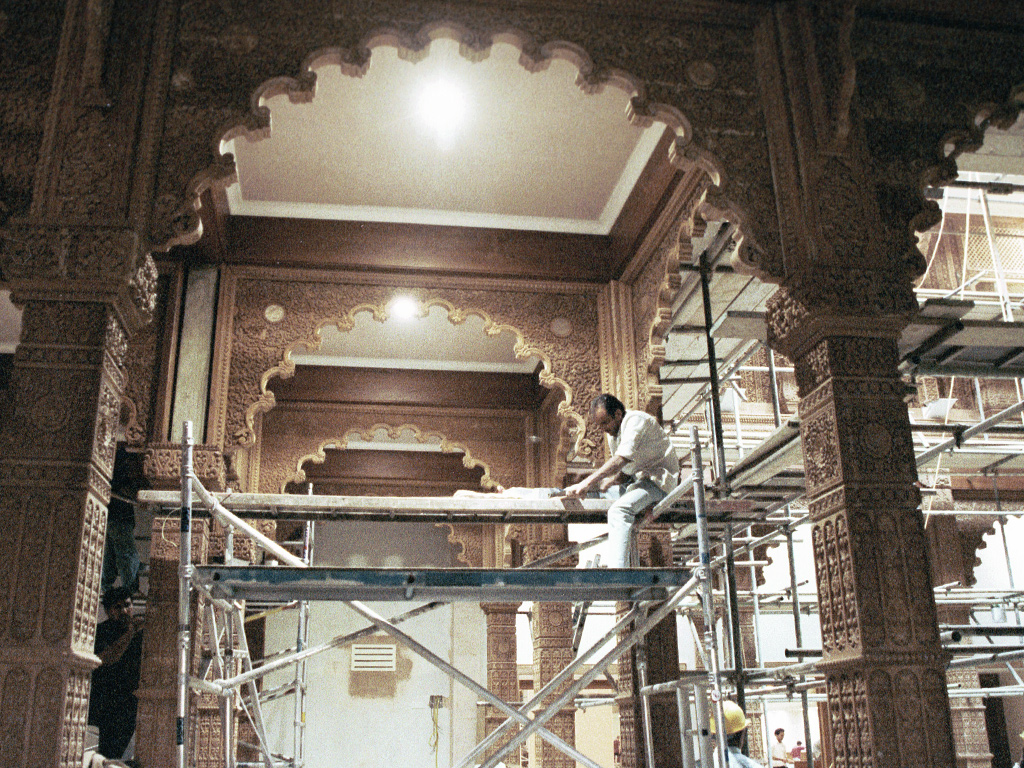
Inside, the foyer leads to two majestic courtyards with soaring teak columns and oak panels. Dancing peacocks, prime lotuses and royal elephants beckon in greeting from around the walls.
Here, too, the columns are connected with cusped arches sporting the sun and moon.
Above, balconies with their protruding balustrades fill the upper floor alongside carved panels replete with floral patterns. Intermittently placed pilasters (partial pillars) and struts rise to meet the lightwell that opens each courtyard to the sky.

Carpet

Complementing the carvings in wood are the traditional designs of the carpet below. Made from blended wool, the pile-woven bespoke broadloom features a blooming lotus medallion surrounded by lush foliage and plumes of colourful feathers.
Together, the symbolic motifs of the Haveli offer a joyous, pious and auspicious welcome to the Mandir.

The Haveli ,How It Was Made


How It Was Made


The Concept & Design

With the Mandir following an almost 200-year-old tradition within the Swaminarayan Sampradaya, it was natural that the adjacent cultural centre would also be in continuation of the havelis found in early 19th century Swaminarayan mandirs, some of them built under the auspices of Bhagwan Swaminarayan himself.
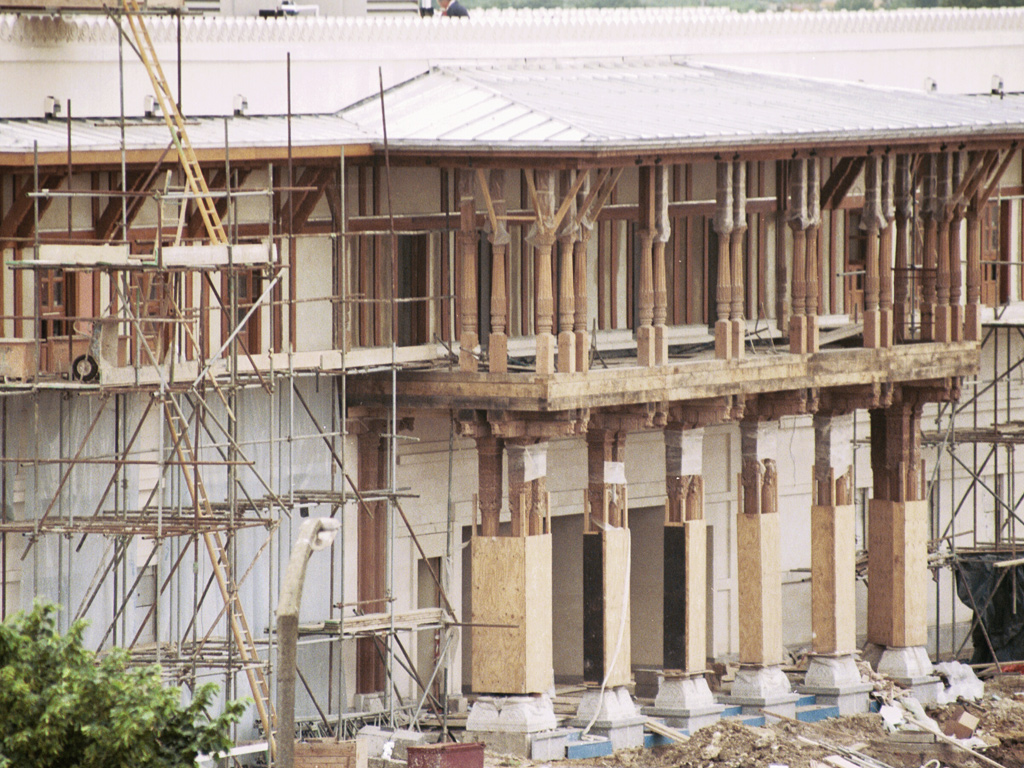
Like the stone mandir, though, a building in London with an intricate wooden façade and internal courtyards posed its own set of novel challenges. So as plans were being discussed, architects and structural engineers from both England and India visited examples of older havelis in India to see what could be possible in London. After much research, deliberation, testing and innovative engineering, working drawings were finalised in late 1992 for a functional and distinctively traditional haveli facility.
To learn more about the history and tradition of Haveli architecture, please click here.

The Wood

Two types of wood were selected for the making of the Haveli – Burmese Teak and English Oak.
Havelis in India have a long history of using Burmese Teak, and with its durability, natural water-resistant qualities and striking wood grain, it was also the perfect choice for the Haveli in London; for the exterior it needed to withstand the harsh British elements, yet its texture was ideal for the delicate carvings both inside and on the façade.
For the load-bearing beams and structural framework, English Oak was chosen because of its sturdiness and durability; its heartwood is said to be naturally resistant to decay.
Importantly, both types of wood were used in an environmentally sensitive way. To learn about how the timber was sourced from managed forests, and how over 10 saplings were planted for each tree felled, please click here.

The Crafting

The Haveli covers over 17,760 square feet of woodcarving. With this form of building having not been attempted for the last 100 years – carpenters had since dabbled in embellished furniture, but little more – it was a challenge to assemble a skilled workforce for a project of this scale and detail.
Eventually, 169 craftsmen were engaged as work began in December 1993. At 8 workshops across India – in Gujarat, Rajasthan, Maharashtra, Uttar Pradesh and Bengal – they chipped and cut and patiently carved away.
Within a year and 8 months, the entire building with its intricately carved wooden features was ready for the opening.

BAPS Mandir in the Making


Mandir in the Making