Showing posts with label The Haveli. Show all posts

Tuesday, 18 December 2012

Environment-Friendly Features


Environment-Friendly Features

Main-Image
"Oh Mother Earth! May our labours be not injurious to you."
– Atharva Veda

With Hinduism’s renowned reverence for nature, it was important that the Mandir incorporated features that were compassionate to the environment.
So from sourcing timber used in the construction of the Haveli, to optimising energy efficiency wherever possible, some of the environmentally sensitive features incorporated into the design and operational today include the following:
  • Burmese Teak used in the Haveli is a controlled tree species and was sourced from a managed forest. Even while plantation teak is considered a renewable resource, several trees were planted for each one felled.
     
  • A total of 226 English Oak trees were also used in the Haveli. In return, 2,300 English Oak saplings were planted in Wiltshire, South West England.
     
  • A thermal heat exchanger in the assembly hall conserves thermal energy dissipated by the congregation and reuses it to heat other parts of the complex.
  • Energy-saving light bulbs are used in the assembly hall and wherever else possible.
     
  • Skylights and partitioning in the assembly hall help to save further energy.
     
  • Strategic light-switch arrangements help minimise energy wastage.
     
  • Timers, sensors and zonal arrangements for lighting and heating also help reduce energy wastage.
     
  • To help the environment and also raise funds for the Mandir, more than 7 million aluminium cans were collected for recycling – one of the largest such recycling projects in the UK.
     
Recognising these efforts, the local Brent Council awarded the Mandir after its opening the 1995 Brent Green Leaf Award for “using environmentally friendly materials and techniques”.
For the Mandir as a whole, every stage of its construction reveals a tender, caring and respectful relationship with nature – from first paying homage to and seeking permission from the earth to build upon it, to finally thanking it when complete and begging forgiveness for any injury incurred in the process.
To this day, the Mandir community is continuing to endeavour in nourishing that relationship and help the environment in further meaningful ways. Some of these small but valuable efforts include:
  • Printing and photo-copying on both sides, reusing single-side printed paper, and thereafter recycling double-sided used paper
     
  • Recycling printer cartridges
     
  • Educating staff and volunteers to save energy by switching off unused lights, monitors and other appliances
     
  • Using chlorine-free paper sourced from well-managed forests and vegetable oil-based inks for large print-run publications
     
  • For large events, using plastic bags made from recycled plastic and which are 100% oxo-biodegradable
     
  • Advocating strict vegetarianism. According to a 2006 UN report, the livestock industry is responsible for 18% of all greenhouse gas emissions from human activities. That’s more than all the world’s cars, trucks, trains, planes and boats combined!
     
  • Raising public awareness about positive life changes for a healthier body and greener planet, such as the Go Veg… Go Green… campaign
     
  • Annually observing the UN’s World Environment Day (5 June) with awareness campaigns and educational packages
     
  • Annually observing Earth Hour (8.30-9.30pm on the last Saturday of March) by switching off all non-essential lights in the Mandir
     
  • Implementing a Green Travel Plan in conjunction with Transport for London, the London Borough of Brent, the Metropolitan Police and WestTrans (a sub-regional transport partnership) to encourage cycling, walking, car sharing and public transport among worshippers and visitors, to reduce single-occupancy car trips to the Mandir
     
A lot more needs to be done of course, and with the growing awareness and everyone’s cooperation, we are quietly confident that we can build on these important efforts and make an even bigger positive difference in the years to come.

BAPS Gymnasium


Gymnasium

The multi-purpose gymnasium is a unique feature of the Mandir. Conceived with the younger generation in mind – ‘those who come to play also learn to pray, and vice versa’ – the sports facility has proven popular with members of all ages, and all abilities.
Measuring 30 metres by 18 metres (100 feet by 60 feet), and rising 7.5 metres (24 feet) high, the spacious area is fully equipped for a variety of sports and games. Football, indoor cricket, netball, badminton, volleyball, dodgeball, basketball and table tennis are regularly played here, supporting the Mandir’s initiative of a healthy body as well as a healthy mind.
Sport also presents with it opportunities for enhancing values such as teamwork, responsibility, grace, and humility. With everyone encouraged to participate, it also becomes an important place for bonding.
Weekly fixtures include badminton evenings and football nights, while several national tournaments for all age groups are hosted here around the year, especially for football, netball and cricket.

BAPS Souvenir Shop


Souvenir Shop

The Souvenir Shop is located in the central foyer of the Haveli, flanked by the two sky-lit courtyards. It is filled with a wide selection of books, postcards, CDs, DVDs, herbal health products, and gifts for all ages, tastes and budgets.
The list below provides an idea of the types of items available.

Books

  • On the Swaminarayan Sampradaya
  • On Hinduism
  • In English, Gujarati and Hindi
  • Pictorials and storybooks for children
  • Popular textbooks on Hinduism

Postcards & Photographs

  • Interior and exterior of the Mandir and Haveli
  • Sacred Images

Music CDs

  • Bhajans (Hindu devotional songs) in Gujarati and Hindi
  • Religious instrumental music
  • Classical and semi-classical Indian music
  • Relaxation music

Video DVDs

  • Festivals of the Swaminarayan Sampradaya
  • Blessings and darshan of HH Pramukh Swami Maharaj

Worship

  • Sculpted murtis of Bhagwan Swaminarayan and other deities
  • Various sizes, in china, porcelain and crystal
  • Puja paraphernalia: arti, divo, ghantadi, kanku (vermillion powder), chandan (sandalwood paste sticks), etc.
  • Shrines for the home and office

Gifts & Handicraft

  • Souvenirs inspired by the Mandir: key chains, pencil cases, pencils, pens, erasers, etc.
  • Handicraft from India

Herbal Health Products

  • Toothpaste, soap, shampoo, oils, etc.
  • All vegetarian and ethically produced

BAPS Assembly Hall


Assembly Hall


The central feature of the Haveli is the assembly hall located behind the foyer. It is the focal point of the weekly assemblies as well as the religious festivals celebrated around the year at the Mandir.
Spanning 50 metres by 45 metres (165 feet by 145 feet), and with no supporting columns, the hall can accommodate up to 2,500 people when fully opened. The main stage, stretching 28 metres (90 feet), is from where the regular sermons and programmes are delivered. With folding partitions, the hall can also be sectioned into two halves or a front half with two back quarters, each with independent lighting and audio-visual facilities as well as its own stage.

Each of the four quadrants is carpeted in the Haveli’s bespoke broadloom, richly patterned and coloured with traditional Indian designs. Surrounding them is polished wooden flooring.
Above, the ceiling comprises of four large lightwells, each surrounded by intricately carved wooden struts (angled supports) and patterned grills. In addition to these natural sources, light is also provided by specially designed suspended lanterns, characteristic of the classic Haveli genre but fitted with energy-saving bulbs.
Also in the ceiling, a thermal heat exchanger conserves the thermal energy dissipated by the congregation and reuses it to heat other parts of the complex.
Other furnishings and mouldings in the hall, such as the arched niches skirting around the upper walls, are also inspired by traditional Haveli architecture.
The assembly hall is where many of the presentations for schools and group visits take place, and is a hub of activity for the thousands of devotees who come to learn, worship and celebrate at the Mandir.

Art & Architecture


Art & Architecture


Main-Image
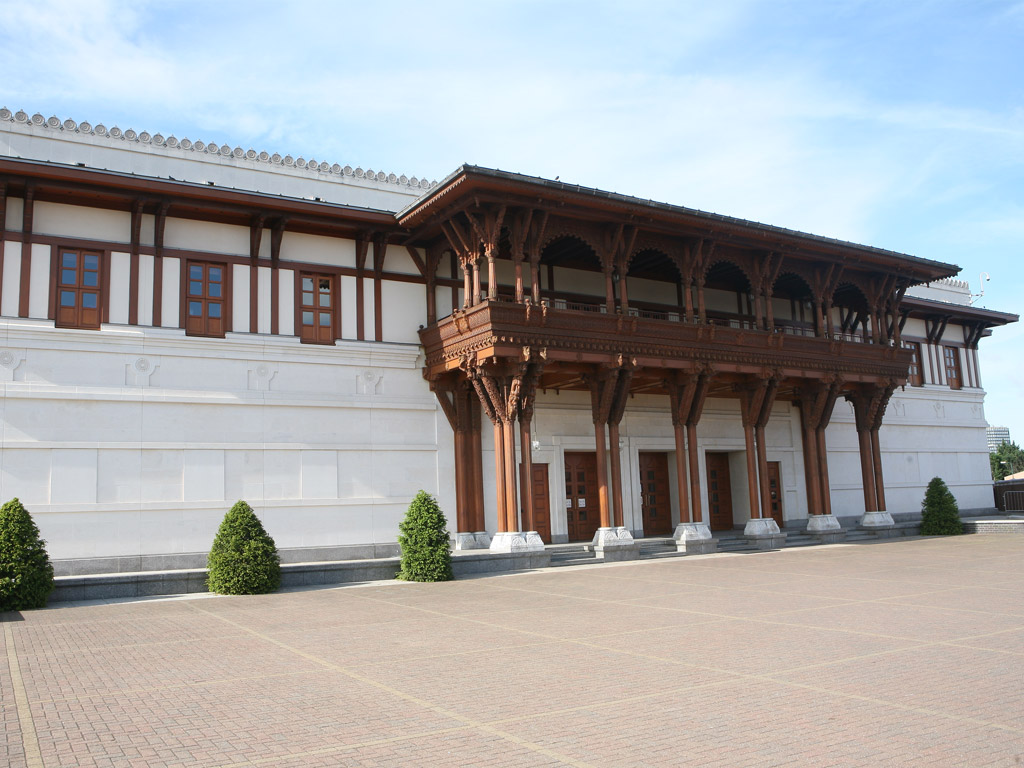
Adjacent to the stone Mandir is the Haveli, a unique cultural centre exquisitely crafted from wood.
Providing modern amenities and built with innovative environment-friendly features, it is a hub of activity for all who come to learn, worship and celebrate at the Mandir.
Intricately carved in Burmese teak and using English Oak, it is a masterpiece of traditional Haveli architecture – a genre that developed around the 17th century in Gujarat and Rajasthan in western India. Characterised by porch façades and central open courtyards, it is known for its array of profusely carved columns, struts (angled supports), arches, doors, windows and balconies.
As a dying art form, not in the past 100 years had such a haveli been created in India or elsewhere.

Façade

The Haveli is entered through the richly carved portico. Atop the fluted columns (‘pillars’) and along the sculpted panels and struts are a breathtaking parade of elephants, lions, peacocks, swans and parrots – all said to accord a cordial and auspicious welcome to worshippers and visitors.
On the upper floor, the balcony’s curvilinear balustrade (enclosing barrier) is a frieze (carved panel) teeming with floral and geometric patterns. The jutting canopy above is supported by tapering columns and twinned struts. In between, cusped arches feature images of the sun and moon – a further salutation to the forces of nature and time.

Courtyards

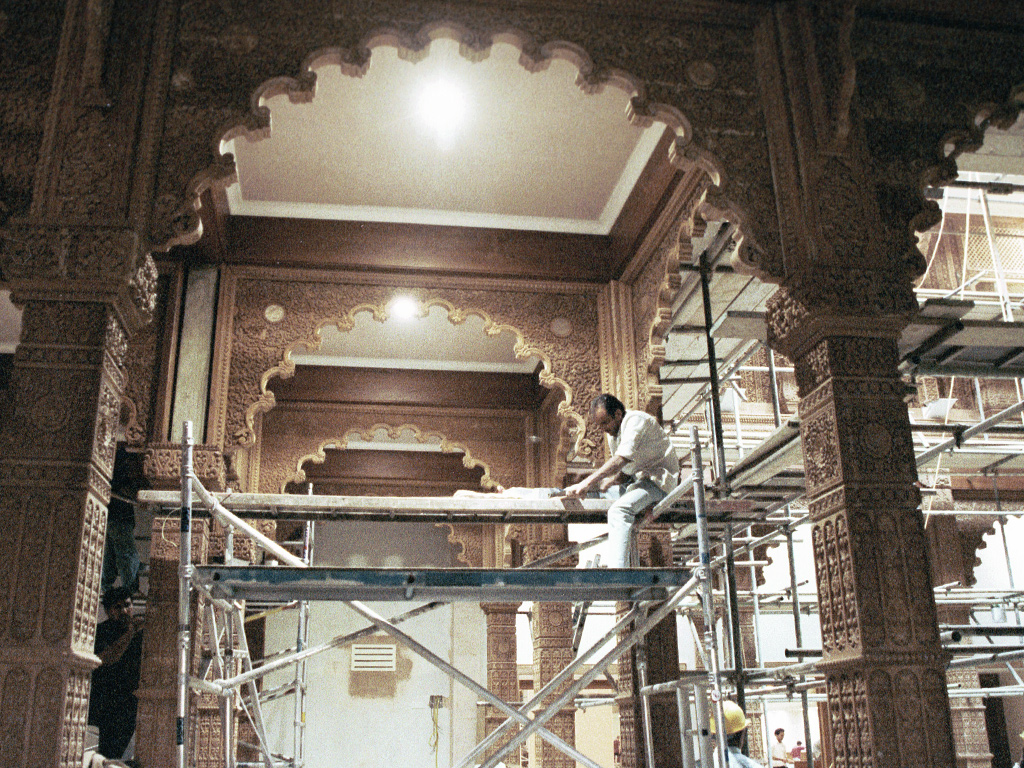
Inside, the foyer leads to two majestic courtyards with soaring teak columns and oak panels. Dancing peacocks, prime lotuses and royal elephants beckon in greeting from around the walls.
Here, too, the columns are connected with cusped arches sporting the sun and moon.
Above, balconies with their protruding balustrades fill the upper floor alongside carved panels replete with floral patterns. Intermittently placed pilasters (partial pillars) and struts rise to meet the lightwell that opens each courtyard to the sky.

Carpet

Complementing the carvings in wood are the traditional designs of the carpet below. Made from blended wool, the pile-woven bespoke broadloom features a blooming lotus medallion surrounded by lush foliage and plumes of colourful feathers.
Together, the symbolic motifs of the Haveli offer a joyous, pious and auspicious welcome to the Mandir.

The Haveli ,How It Was Made


How It Was Made


The Concept & Design

With the Mandir following an almost 200-year-old tradition within the Swaminarayan Sampradaya, it was natural that the adjacent cultural centre would also be in continuation of the havelis found in early 19th century Swaminarayan mandirs, some of them built under the auspices of Bhagwan Swaminarayan himself.
Like the stone mandir, though, a building in London with an intricate wooden façade and internal courtyards posed its own set of novel challenges. So as plans were being discussed, architects and structural engineers from both England and India visited examples of older havelis in India to see what could be possible in London. After much research, deliberation, testing and innovative engineering, working drawings were finalised in late 1992 for a functional and distinctively traditional haveli facility.
To learn more about the history and tradition of Haveli architecture, please click here.

The Wood

Two types of wood were selected for the making of the Haveli – Burmese Teak and English Oak.
Havelis in India have a long history of using Burmese Teak, and with its durability, natural water-resistant qualities and striking wood grain, it was also the perfect choice for the Haveli in London; for the exterior it needed to withstand the harsh British elements, yet its texture was ideal for the delicate carvings both inside and on the façade.
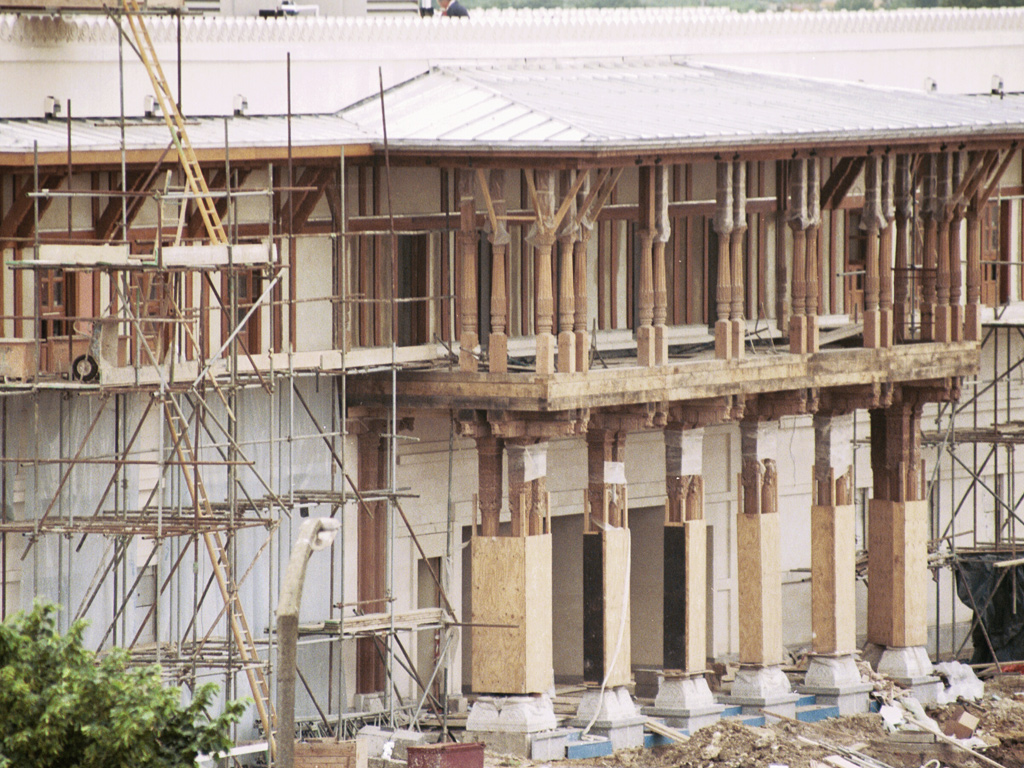
For the load-bearing beams and structural framework, English Oak was chosen because of its sturdiness and durability; its heartwood is said to be naturally resistant to decay.
Importantly, both types of wood were used in an environmentally sensitive way. To learn about how the timber was sourced from managed forests, and how over 10 saplings were planted for each tree felled, please click here.

The Crafting

The Haveli covers over 17,760 square feet of woodcarving. With this form of building having not been attempted for the last 100 years – carpenters had since dabbled in embellished furniture, but little more – it was a challenge to assemble a skilled workforce for a project of this scale and detail.
Eventually, 169 craftsmen were engaged as work began in December 1993. At 8 workshops across India – in Gujarat, Rajasthan, Maharashtra, Uttar Pradesh and Bengal – they chipped and cut and patiently carved away.
Within a year and 8 months, the entire building with its intricately carved wooden features was ready for the opening.